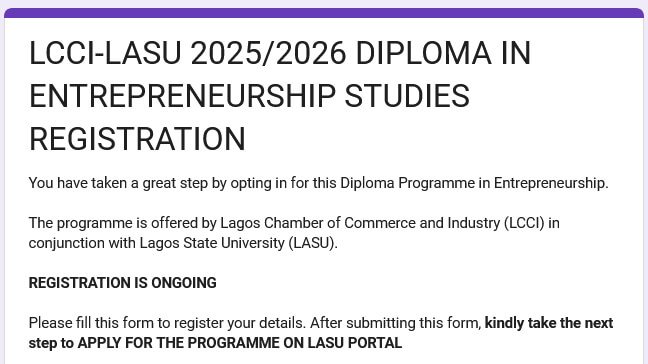
Entrepreneurship is no longer just about having a good idea , it is about building sustainable businesses that can survive competition, regulation, and economic uncertainty. Recognizing this reality, the Lagos Chamber of Commerce and Industry (LCCI) has partnered with Lagos State University (LASU) to launch the 2025–2026 Diploma in Entrepreneurship Programme, a career-focused initiative designed to equip Nigerian entrepreneurs with business skills.
The programme is tailored for aspiring entrepreneurs, startup founders, and MSME owners who want structured training, practical exposure, and a recognised qualification that supports business growth and career advancement.
Officially unveiled in Lagos, the diploma programme reflects a growing national push to strengthen Micro, Small and Medium Enterprises (MSMEs), which account for over 90% of businesses in Nigeria and remain a major driver of employment and economic development.
About the LCCI–LASU Partnership
The collaboration brings together two institutions with complementary strengths:
Lagos Chamber of Commerce and Industry (LCCI) : Nigeria’s foremost private sector and business membership organisation, known for enterprise development, policy advocacy, and mentorship.
Lagos State University (LASU) : a reputable public university with strong academic credentials and professional training structures.
By combining industry expertise with academic rigour, the partnership bridges the long-standing gap between classroom learning and real business practice.
This diploma is delivered through LASU Consult, the university’s professional and consultancy arm, ensuring the programme meets both academic and industry standards.
What Is the LCCI–LASU Diploma in Entrepreneurship?
The Diploma in Entrepreneurship Programme (2025/2026) is a professional, university-backed qualification designed to help participants:
Start new businesses with clarity and structure
Improve existing business operations
Scale MSMEs sustainably
Gain practical management and leadership skills
Unlike theory-heavy courses, this programme focuses on hands-on learning, case studies, mentorship, and real-life business problem-solving.
Programme Objectives
The programme aims to:
Strengthen MSME leadership and management capacity
Promote sustainable enterprise growth
Improve financial discipline and business planning
Encourage innovation and digital adoption
Support Nigeria’s broader economic diversification goals
Participants are trained not just to run businesses, but to build enterprises that can grow, attract funding, and withstand market pressures.
Detailed Curriculum Overview
The curriculum is structured around the core competencies required to run and scale a successful business in Nigeria.
Main Courses Covered
1. Business Model Development
Participants learn how to:
Design viable business models
Identify value propositions
Understand customer segments and revenue streams
2. Financial Management and Accounting
This module focuses on:
Cash flow management
Basic accounting principles
Budgeting and cost control
Financial decision-making for entrepreneurs
3. Marketing Strategy and Customer Engagement
Covers:
Branding and positioning
Customer acquisition strategies
Digital marketing fundamentals
Retention and customer experience
4. Business Planning and Pitching
Participants are trained to:
Write bankable business plans
Prepare investor-ready pitch decks
Communicate business ideas confidently
5. Operations, Risk, and Compliance Management
This module addresses:
Business processes and efficiency
Regulatory compliance in Nigeria
Risk identification and mitigation
6. Digital Transformation for Business Growth
Focus areas include:
Using digital tools for operations
E-commerce and online presence
Technology adoption for scalability
Practical Learning and Mentorship
One of the strongest features of the programme is its practical orientation.
Participants benefit from:
Real-life case studies
Group projects and simulations
Practical exercises based on Nigerian business realities
Mentorship from experienced entrepreneurs and industry leaders
Peer collaboration and networking opportunities
This approach ensures graduates leave with skills they can immediately apply.
Who Should Apply?
The programme is open to a wide range of participants, including:
Young entrepreneurs launching startups
Small and medium business owners seeking formal training
Aspiring business leaders and consultants
Innovators and professionals transitioning into entrepreneurship
The organisers emphasise inclusivity, welcoming applicants from diverse sectors across Lagos and other states.
Eligibility Requirements
To qualify for the LCCI–LASU Diploma in Entrepreneurship, applicants must meet the following criteria:
Possess a Senior Secondary School Certificate (SSCE)
Be 16 years and above
Demonstrate basic communication skills
Show willingness to learn and adapt to new technologies
No prior business ownership is required, making the programme suitable for beginners and experienced entrepreneurs alike.
Benefits of the Programme
Participants stand to gain several career and business advantages, including:
Industry-recognised diploma certificate
Direct entry opportunities into full-time degree programmes at LASU
Weekend and hybrid learning formats for flexibility
Access to the LCCI Entrepreneurship Mentoring Programme (EMP)
Strong professional networks with business leaders and investors
These benefits make the programme particularly attractive to working professionals and business owners.
Class Format and Study Mode
The programme is designed to fit around busy schedules.
Study Options Include:
Weekend classes
Hybrid learning (physical and online sessions)
This flexibility ensures participants can combine learning with work or business responsibilities.
Class Venue
All physical classes will hold at:
LCCI Conference and Exhibition Centre
10, Nurudeen Olowopopo Street,
Alausa, Ikeja, Lagos State
The venue provides a professional business environment suitable for learning and networking.
Expected Outcomes for MSMEs
Graduates of the programme are expected to:
Manage finances more effectively
Build competitive and scalable business models
Improve operational efficiency
Navigate regulatory and compliance challenges
Leverage digital tools for growth
These outcomes align with national efforts to boost employment, innovation, and MSME contribution to GDP.
How to Apply for LCCI–LASU Diploma in Entrepreneurship 2025/2026
Interested applicants should apply online using the official application form.
Application Steps:
Visit the application portal:
👉 https://forms.gle/tMVi1ck8j7wEyFwp8Complete the online form accurately
Submit required details
Await further communication from the organizers
Early application is strongly advised, as slots may be limited.
Frequently Asked Questions (FAQ)
Is the diploma certificate recognised?
Yes. The programme is delivered through LASU Consult and supported by LCCI, making it both academically and industry recognised.
Can I work while studying?
Yes. The programme is designed with weekend and hybrid classes to support working professionals.
Does this programme guarantee business funding?
No direct funding is guaranteed, but participants gain access to mentorship, networks, and investor exposure.
Can I use the diploma for further studies?
Yes. The programme offers direct entry pathways into full-time LASU degree programmes.
Is the programme only for Lagos residents?
No. Applicants from across Nigeria are welcome, especially due to the hybrid learning option.
Conclusion
The LCCI–LASU Diploma in Entrepreneurship Programme 2025/2026 is more than a certificate, it is a structured pathway for Nigerians who want to build sustainable businesses and competitive careers.
By combining academic credibility, industry relevance, mentorship, and flexible learning, the programme offers practical value for entrepreneurs at every stage.
For anyone serious about entrepreneurship, MSME growth, or business leadership in Nigeria, this diploma represents a smart investment in skills, networks, and long-term success.
💡 Stay Empowered with NgEmpower
Join our community for daily updates on jobs, skills, and financial growth opportunities.