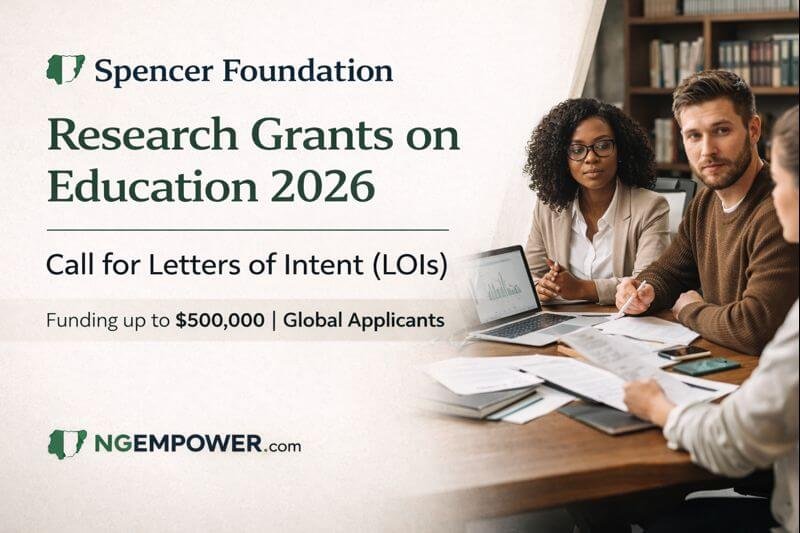
The Spencer Foundation has opened its 2026 Call for Letters of Intent (LOIs) under its flagship Research Grants on Education programme, inviting scholars worldwide to propose ambitious, field-initiated studies that advance understanding of education.
Widely regarded as one of the most respected private funders of education research, the Spencer Foundation supports work that shapes long-term thinking about learning, schooling, and education systems, rather than short-term program delivery or evaluation.
For researchers seeking substantial, flexible funding for rigorous inquiry, the 2026 cycle marks an important opportunity.
What Makes the Spencer Foundation Distinct
Unlike many grant-makers, the Spencer Foundation funds research for knowledge-building, not service delivery. Its grants are designed to support studies that influence:
Educational theory
Policy debates
Professional practice
Public understanding of education
This focus has positioned Spencer-funded research at the center of major conversations on equity, learning, institutions, and educational change.
What a Letter of Intent Means in This Process
The Letter of Intent (LOI) is a required first step and serves as a competitive screening stage. At this phase, applicants are expected to clearly outline:
The education-related problem or question driving the study
The conceptual and scholarly significance of the research
The broad methodological approach
The potential contribution to education knowledge
Only proposals that demonstrate strong alignment with the Foundation’s priorities at the LOI stage are invited to submit full applications.
What’s New in the 2026 Funding Cycle
Starting in 2026, the Spencer Foundation has shifted to a single annual application cycle. This change consolidates submissions into one review period each year while allowing the Foundation to support a larger number of projects overall.
For applicants, this means:
One annual deadline to plan for
A more competitive review pool
Clearer timelines for multi-year research planning
Who Should Consider Applying
The programme is open to education researchers at different career stages, including:
Early-career scholars with independent research agendas
Established researchers leading large-scale or longitudinal studies
International scholars examining education in diverse contexts
Career seniority is less important than the strength of the research idea, methodological clarity, and anticipated contribution.
Eligibility in Plain Terms
Applicants must hold a doctoral degree and be formally affiliated with a public or nonprofit institution capable of administering research funds. Projects must focus squarely on education and be proposed in English, with budgets presented in U.S. dollars.
Researchers may not hold more than one active Spencer research grant at a time.
What the Foundation Will Not Fund
The Spencer Foundation does not support:
Program implementation or service delivery
Evaluations of existing initiatives
Curriculum or technology development
Commercial or for-profit research activity
Applications that blur the line between research and implementation are rarely competitive.
Research Priorities and Scholarly Fit
Rather than prescribing topics, the Foundation prioritizes conceptual depth and scholarly ambition. Strong proposals often examine:
Learning across the lifespan
Education within and beyond formal school settings
Structural, social, or institutional influences on education
Questions with relevance beyond a single site or population
The emphasis is on research that remains valuable well after the grant period ends.
Methodological Expectations
The programme supports a wide range of research approaches, including quantitative, qualitative, mixed-methods, historical, ethnographic, and participatory designs. What matters most is that the methodology is well matched to the research question and clearly justified.
Why the Grant Is Highly Competitive
Spencer Foundation grants are competitive because reviewers look for:
Clearly articulated and consequential research questions
Strong methodological grounding
Evidence of originality and scholarly independence
Potential for long-term influence on the field
Funding ranges from $125,000 to $500,000 for projects lasting one to five years, with budgets assessed for realism rather than size.
Application Process at a Glance
Review the 2026 LOI guidelines on the Spencer Foundation website
Prepare and submit a Letter of Intent through the online portal
Await notification on whether a full proposal is invited
Submit a complete proposal if shortlisted
Participate in the review process as required
Key Dates
LOI Deadline: 24 February 2026
Funding Cycle: Annual (starting 2026)
For more information, visit Spencer Foundation.
Final Note to Researchers
The Spencer Foundation Research Grants on Education remain one of the most credible funding opportunities for scholars committed to advancing education knowledge at scale. For researchers with carefully developed ideas and a clear sense of contribution, the 2026 call offers a platform to pursue work with lasting relevance.
💡 Stay Empowered with NgEmpower
Join our community for daily updates on jobs, skills, and financial growth opportunities.