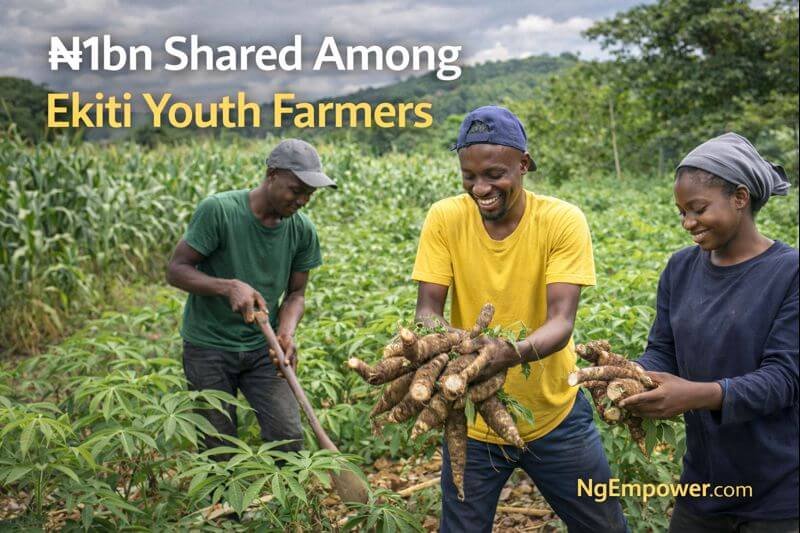
The Ekiti State Government has paid out ₦1 billion to 4,657 young people participating in its agriculture empowerment drive, marking another major milestone in the state’s efforts to turn farming into a reliable source of income for youths.
The payout, which was announced in Ado-Ekiti, represents profits generated from large-scale farming activities carried out under the state’s Bring Back Our Youths in Agriculture programme. According to the government, the money was not taken from loans or grants but earned directly from the sale of farm produce cultivated by beneficiaries across different parts of the state.
Profits, Not Handouts
Speaking on the development, the Commissioner for Agriculture and Food Security explained that the payment reflects the state’s decision to run agriculture as a business rather than a welfare scheme.
He said the youths involved were engaged in real farming operations, supported with land preparation, inputs, technical guidance, and access to markets. At harvest, the produce was sold, and the proceeds shared transparently among participants.
“This is not free money,” the commissioner said. “These are returns from farming activities the youths took part in. What we are doing is helping them earn, not depend.”
Who the Beneficiaries Are
The 4,657 beneficiaries are young men and women drawn from different local government areas in Ekiti. Many of them were previously unemployed or underemployed before joining the programme.
Some are first-time farmers, while others had farming backgrounds but lacked the scale, tools, or coordination to earn meaningful income. Through the programme, they were grouped into clusters and assigned to specific farming activities based on location and suitability.
The state government says priority was given to youths willing to work collectively and commit to the full farming cycle, from planting to harvest.
How the Programme Works
The Ekiti youth agriculture programme operates on a shared-responsibility model. The government provides access to land, inputs such as seedlings and fertilisers, extension services, and coordination. The youths provide labour and day-to-day farm management.
Farming is done in clusters spread across different zones of the state to reduce risk and ensure steady production. Crops cultivated include maize, cassava, rice, vegetables, and other staples suited to Ekiti’s soil and climate.
At harvest, produce is aggregated and sold through organised channels to avoid middlemen exploiting individual farmers. Profits are then calculated and shared among participants based on agreed terms.
Not the First Payout
State officials noted that this is not the first time proceeds from the programme are being paid to beneficiaries. Previous farming cycles have also produced returns, though the latest ₦1 billion payout is the largest so far.
The commissioner said the increasing size of the payouts shows that the programme is gaining strength as more land is cultivated and farming practices improve.
He added that lessons from earlier cycles helped the government improve planning, reduce losses, and negotiate better prices for farm produce.
Why Ekiti Is Pushing Youths Into Agriculture
Ekiti’s agriculture empowerment programme is part of a broader push to tackle youth unemployment while boosting food production in the state.
Officials say the state cannot rely on white-collar jobs alone to absorb its growing youth population. Agriculture, when properly organised, offers opportunities for income, skills development, and food security.
By engaging young people directly in farming, the government hopes to reduce rural-urban migration and rebuild interest in agriculture as a viable livelihood.
Food Security Angle
Beyond income for youths, the state says the programme also supports local food supply. Large volumes of food produced through the farming clusters are sold within Ekiti and neighbouring states, helping to stabilise prices and reduce dependence on food imports.
Agriculture officials believe that consistent production from organised youth farms can play a role in cushioning the impact of rising food costs on households.
What the ₦1bn Means for Beneficiaries
For many of the youths involved, the payout represents their first major earnings from farming. Some beneficiaries said the money would help them meet personal needs, reinvest in farming, or support small businesses.
Government officials encouraged participants to see the payout as a foundation rather than a one-off benefit, urging them to remain committed to future farming cycles.
Looking Ahead
The Ekiti State Government says it plans to expand the programme by bringing in more youths and increasing cultivated land in the next farming season. Officials also hinted at plans to introduce more value-added activities, such as processing, to boost earnings.
As the state continues to roll out its Ekiti government agriculture initiative, the focus remains on making farming profitable enough to keep young people engaged and financially independent.
For now, the ₦1 billion payout stands as a clear signal that agriculture, when properly managed, can deliver real income for Nigerian youths while strengthening food production at the same time.
💡 Stay Empowered with NgEmpower
Join our community for daily updates on jobs, skills, and financial growth opportunities.