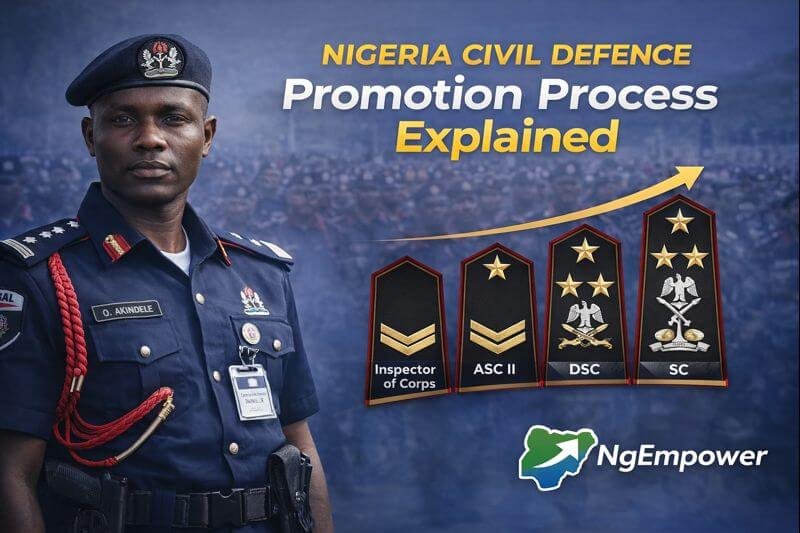
Promotion in the Nigeria Security and Civil Defence Corps (NSCDC) is one of the most important aspects of an officer’s career. It determines not only salary growth, but also authority, responsibility, posting opportunities, and long-term career progression.
Many serving officers and aspiring recruits often ask questions such as how promotion works in the Civil Defence, how long promotion takes, what exams are required, and why some officers remain on the same rank for many years.
This guide explains the Nigeria Civil Defence promotion process in clear and practical terms, so you understand exactly how the system works, what is expected of officers, and how to prepare properly for advancement.
How Promotion Works in the Nigeria Civil Defence Corps
Promotion in the Nigeria Civil Defence Corps is the official advancement of an officer from one rank to the next higher rank. Every promotion comes with:
Higher responsibility
Increased authority
Improved salary and allowances
Greater leadership expectations
However, promotion is not automatic. An officer can serve many years at a particular rank and still not be promoted if the required conditions are not met.
The promotion system in the NSCDC is designed to reward officers who demonstrate discipline, competence, professionalism, and readiness for higher responsibility.
Bodies Responsible for Civil Defence Promotion in Nigeria
Two main authorities are involved in the promotion process.
Nigeria Security and Civil Defence Corps (NSCDC)
The NSCDC conducts internal assessments such as:
Promotion examinations
Performance evaluations
Training recommendations
Service record reviews
Federal Civil Service Authorities
Promotion approvals follow federal civil service rules and guidelines. Senior promotions are subject to higher-level approval in line with public service regulations.
In simple terms, the Civil Defence Corps assesses eligibility and performance, while final approval follows federal service procedures.
Promotion in Civil Defence Is Rank by Rank
One important rule in the NSCDC promotion system is that promotion follows a strict hierarchy.
Key points to understand include:
Officers are promoted step by step
Skipping ranks is not allowed under normal circumstances
Each rank must be earned before moving to the next
This applies to both junior and senior cadres within the Civil Defence Corps.
We have written a detailed guide on Full List of Nigeria Civil Defence Ranks and Salary Structure 2026 on NgEmpower.com
Nigeria Civil Defence Promotion Ladder Explained
Promotion in the NSCDC follows a defined rank progression.
Junior Cadre Promotion Path
Assistant Cadre III
Assistant Cadre II
Assistant Cadre I
Assistant Inspector of Corps (AIC)
Inspector of Corps (IC)
Superintendent Cadre Promotion Path
Assistant Superintendent of Corps II (ASC II)
Assistant Superintendent of Corps I (ASC I)
Deputy Superintendent of Corps (DSC)
Superintendent of Corps (SC)
Commandant Cadre Promotion Path
Chief Superintendent of Corps (CSC)
Assistant Commandant of Corps (ACC)
Deputy Commandant of Corps (DCC)
Commandant of Corps (CC)
Top Command Promotion Path
Assistant Commandant General of Corps (ACGC)
Deputy Commandant General of Corps (DCGC)
Commandant General of Corps (CGC)
Each promotion level comes with increased command authority and responsibility.
Basic Requirements for Promotion in Nigeria Civil Defence
To be considered for promotion, an officer must meet several conditions. These conditions apply across all cadres, although details may vary by rank.
General Promotion Requirements
Completion of the required minimum years at the current rank
Successful completion of promotion examinations
Clean disciplinary and service record
Completion of mandatory training courses
Recommendation by superior officers
Failure to meet any of these requirements can delay promotion.
Years of Service and Promotion Timeline in NSCDC
Years of service are an important factor in promotion, but they do not guarantee advancement.
Typical timelines include:
Assistant Cadre to AIC: about 2 to 3 years
AIC to IC: about 3 years
IC to ASC II: varies based on entry route
ASC II to ASC I: about 3 years
ASC I to DSC: about 3 to 4 years
DSC to SC: about 4 years
Senior and command cadre promotions often take longer due to limited slots and higher responsibility.
Meeting the minimum years of service only makes an officer eligible for consideration. It does not automatically result in promotion.
Nigeria Civil Defence Promotion Examination Explained
Promotion examinations play a central role in the NSCDC promotion process.
What the Promotion Exams Test
Knowledge of Civil Defence duties
Understanding of laws and regulations
Ethics and discipline
Leadership and supervisory skills
Administrative and operational competence
For higher ranks, the exams focus more on management, command, and strategic decision-making.
An officer who fails the promotion examination will not be promoted, regardless of years of service.
Training and Courses Required for Promotion
Training is a compulsory requirement for promotion in the Civil Defence Corps.
Before promotion, officers must attend approved courses related to their next rank. These courses may cover:
Leadership development
Security operations
Disaster management
Intelligence and surveillance
Administrative procedures
Training is conducted at NSCDC training institutions and other approved centers.
Failure to attend or complete required training can delay promotion indefinitely.
Performance and Discipline in Promotion Decisions
Performance and discipline are taken very seriously in promotion decisions.
An officer may be denied promotion if they have:
Unresolved disciplinary cases
Serious misconduct records
Poor performance evaluations
Even if an officer passes promotion exams and meets service years, discipline issues can stop promotion.
Promotion is seen as a reward for officers who uphold integrity, professionalism, and the values of the Civil Defence Corps.
Promotion From Inspector of Corps to Superintendent Cadre
This transition is one of the most important career milestones in the NSCDC.
Moving into the Superintendent Cadre means taking on:
Greater leadership responsibility
Administrative duties
Broader command authority
Because of this, promotion into the Superintendent Cadre is competitive and requires strong performance, successful exams, training completion, and good recommendations.
Promotion Versus Direct Entry in Nigeria Civil Defence
Promotion and direct entry are often confused, but they are not the same.
Promotion
Applies to serving Civil Defence officers
Officers rise gradually through the ranks
Based on service, exams, training, and performance
Direct Entry
Applies to civilians with educational qualifications
Allows entry at higher ranks such as ASC II or ASC I
It is a recruitment method, not a promotion
Both routes are legitimate but follow different processes.
How Salary Changes After Promotion in NSCDC
Promotion has a direct impact on salary and allowances.
Each promotion leads to:
Higher basic salary
Increased allowances
Improved benefits
The difference becomes more noticeable at senior and command ranks. This is why promotion is essential for long-term financial stability in the Civil Defence Corps.
Common Reasons Civil Defence Promotions Are Delayed
Promotion delays are common and usually occur due to:
Failure in promotion examinations
Incomplete training requirements
Disciplinary issues
Limited promotion slots
Administrative or documentation problems
Understanding these reasons helps officers prepare better and avoid unnecessary setbacks.
Can Civil Defence Officers Skip Ranks
Under normal circumstances, Civil Defence officers cannot skip ranks.
The NSCDC promotion system is structured and sequential. Any exception must follow federal civil service rules and is extremely rare.
Frequently Asked Questions About Civil Defence Promotion
How often are promotions done in NSCDC
Promotions are conducted periodically, depending on approvals and available vacancies.
Are promotion exams compulsory
Yes. Promotion examinations are mandatory for most ranks.
Does education affect Civil Defence promotion
Yes. Higher education improves promotion prospects, especially for senior ranks.
How long does promotion take in NSCDC
Promotion timelines vary based on rank, performance, discipline, and available slots.
Final Thoughts
The Nigeria Civil Defence promotion process is structured, competitive, and performance-based. While it can be slow, it is designed to reward officers who demonstrate discipline, competence, and readiness for higher responsibility.
Understanding how promotion works allows officers to plan their careers wisely, prepare properly for exams and training, and avoid unnecessary frustration.
This guide serves as a core reference for Civil Defence career progression on NgEmpower.com and complements existing content on ranks, salary structure, and recruitment.
💡 Stay Empowered with NgEmpower
Join our community for daily updates on jobs, skills, and financial growth opportunities.