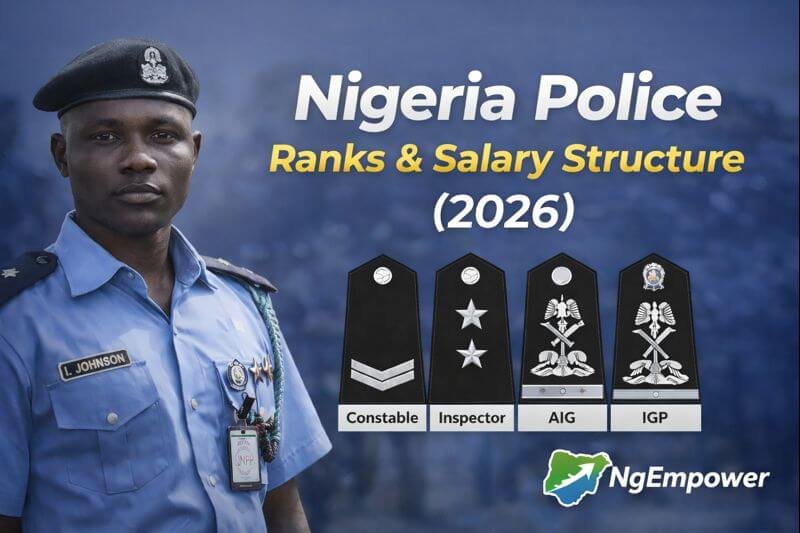
The Nigeria Police Force (NPF) plays a critical role in maintaining internal security, enforcing laws, and protecting lives and property across the country. One of the most searched questions about the police force is: how much do Nigeria Police officers earn, and how does salary differ by rank?
This has made the topic “Nigeria Police ranks and salary structure” extremely important for:
Aspiring police recruits
Serving officers
Students and researchers
Nigerians interested in government salary structures
In this comprehensive and authoritative guide, you will learn:
The full Nigeria Police salary structure by rank
The difference between junior and senior officers’ pay
How allowances increase take-home salary
Promotion impact on salary
Entry requirements and responsibilities
Answers to the most frequently asked questions
Overview of the Nigeria Police Force (NPF)
The Nigeria Police Force is the principal law enforcement agency in Nigeria. It operates under federal authority and is empowered to:
Prevent and detect crime
Maintain public order
Protect citizens and property
Enforce laws and regulations
Support internal security operations
Police officers operate at different levels of authority depending on their rank, and each rank comes with specific responsibilities, command power, and salary.
Nigeria Police Salary Structure Explained (CONPSS)
The Nigeria Police salary system operates under the Consolidated Police Salary Structure (CONPSS).
This structure determines:
Basic monthly salary
Annual salary scale
Rank-based pay differences
However, basic salary is only one part of total earnings. Officers also receive:
Allowances
Benefits
Incentives (depending on duty and posting)
Important: Figures in this guide focus on basic salary, not including allowances, which can significantly increase total monthly income.
Nigeria Police Salary at a Glance
| Category | Details |
|---|---|
| Organization | Nigeria Police Force |
| Salary Structure | CONPSS |
| Lowest Monthly Salary | ₦43,000 (Constable) |
| Highest Monthly Salary | ₦900,000+ (IGP) |
| Average Officer Salary | ₦120,000 – ₦150,000 |
| Salary Increases | Promotion, allowances, years of service |
Nigeria Police Ranks and Salary Structure (Lowest to Highest)
Below is a detailed breakdown of Nigeria Police ranks and their salaries, starting from the lowest rank to the highest rank.
Junior Police Ranks and Salaries
Junior officers form the backbone of the Nigeria Police Force. They handle field duties, patrols, traffic control, and direct law enforcement.
1. Police Recruit
A Police Recruit is an individual undergoing training at a police college.
Monthly Allowance: ₦9,000 – ₦12,000
Status: Trainee
Role: Training in discipline, law, and policing
Recruits do not earn full salary until training is completed.
2. Police Constable (Lowest Operational Rank)
The Constable is the entry-level operational rank.
Monthly Salary: ₦43,000 – ₦45,000
Annual Salary: ₦520,000+
Responsibilities:
Patrol duties
Traffic control
Crime prevention
Assisting investigations
This is the lowest paid rank in the Nigeria Police Force.
3. Corporal
Corporals are junior supervisors.
Monthly Salary: ₦48,000 – ₦50,000
Responsibilities:
Supervises Constables
Leads small patrol units
Reports to Sergeants
4. Sergeant
Sergeants are key field leaders.
Monthly Salary: ₦55,000 – ₦60,000
Responsibilities:
Supervises Corporals
Coordinates patrol activities
Enforces discipline
5. Sergeant Major
The highest non-commissioned officer rank.
Monthly Salary: ₦62,000 – ₦65,000
Role:
Senior supervision of junior officers
Acts as liaison between junior and senior ranks
Senior Police Ranks and Salaries
Senior officers are responsible for command, administration, strategy, and policy enforcement.
6. Inspector of Police
Inspector is the entry rank into commissioned officers.
Monthly Salary: ₦85,000 – ₦90,000
Responsibilities:
Commands police stations
Oversees investigations
Supervises junior officers
7. Assistant Superintendent of Police (ASP)
ASP is often the starting rank for graduates.
Monthly Salary: ₦150,000 – ₦160,000
Entry Route:
Nigeria Police Academy
Direct Entry
8. Deputy Superintendent of Police (DSP)
DSPs hold important leadership positions.
Monthly Salary: ₦170,000 – ₦180,000
Responsibilities:
Divisional command
Personnel management
Operational planning
9. Superintendent of Police (SP)
SPs manage large divisions.
Monthly Salary: ₦185,000 – ₦190,000
Responsibilities:
Supervises DSPs and ASPs
Coordinates major operations
10. Chief Superintendent of Police (CSP)
CSPs are senior operational commanders.
Monthly Salary: ₦195,000 – ₦205,000
Role:
Oversees multiple divisions
Advises higher command
11. Assistant Commissioner of Police (ACP)
Monthly Salary: ₦210,000 – ₦220,000
Responsibilities:
Supervises area commands
Implements security strategies
12. Deputy Commissioner of Police (DCP)
Monthly Salary: ₦275,000 – ₦285,000
Role:
Second-in-command at state level
Coordinates large-scale operations
13. Commissioner of Police (CP)
The head of police operations in a state.
Monthly Salary: ₦300,000 – ₦310,000
Responsibilities:
Overall security management
Reports to AIG or DIG
14. Assistant Inspector General of Police (AIG)
Monthly Salary: ₦520,000 – ₦550,000
Role:
Oversees multiple state commands
Zonal security coordination
15. Deputy Inspector General of Police (DIG)
Monthly Salary: ₦850,000 – ₦900,000
Responsibilities:
National strategic leadership
Supervises major departments
16. Inspector General of Police (IGP) – Highest Rank
The IGP is the overall head of the Nigeria Police Force.
Monthly Salary: ₦900,000+
Duties:
Commands the entire police force
Advises the President on security
Sets national policing policy
Nigeria Police Allowances and Benefits
Police officers earn more than their basic salary through allowances such as:
Housing / Rent allowance
Transport allowance
Hazard (risk) allowance
Uniform allowance
Medical benefits
Pension and gratuity
Officers not living in barracks receive rent allowance, while those in high-risk areas earn risk allowance.
These benefits can increase take-home pay by 30–60%.
Minimum Qualification to Join Nigeria Police
To join the Nigeria Police Force, applicants must:
Be a Nigerian citizen
Possess a National Identification Number (NIN)
Be between 18 and 25 years old
Have SSCE (WAEC/NECO) minimum
Be physically and mentally fit
Have no criminal record
Higher qualifications can lead to direct entry at higher ranks.
Responsibilities of Nigerian Police Officers
Regardless of rank, officers are expected to:
Maintain law and order
Protect lives and property
Prevent and detect crime
Conduct patrols and surveillance
Engage communities
Senior officers additionally handle policy, strategy, and command decisions.
Promotion and Salary Growth in Nigeria Police
Promotion leads to:
Higher basic salary
Increased allowances
Greater authority
Promotion is based on:
Years of service
Professional exams
Performance evaluations
Training and discipline
FAQs – Nigeria Police Ranks and Salary Structure
What is the lowest rank in Nigeria Police?
Police Constable is the lowest operational rank.
What is the highest paid rank?
Inspector General of Police (IGP).
Do police officers earn allowances?
Yes, allowances form a major part of total earnings.
Is Nigeria Police salary good?
Entry salaries are modest, but long-term growth is strong.
Can graduates earn more in Nigeria Police?
Yes, graduates can enter at ASP level.
Conclusion
The Nigeria Police ranks and salary structure reflects responsibility, authority, and years of service. While junior officers earn modest salaries, promotion, allowances, and experience significantly improve income over time.
For a complete hierarchy, see the full list of Nigeria Police ranks from lowest to highest, and explore related guides on recruitment, promotion, and police allowances.
💡 Stay Empowered with NgEmpower
Join our community for daily updates on jobs, skills, and financial growth opportunities.