Understanding the Nigeria Police Force (NPF) rank structure is important for students, job seekers, researchers, and anyone interested in Nigeria’s security system. Whether you are preparing for a police recruitment exercise, working on an academic project, or simply curious, knowing the full list of Nigeria Police ranks from lowest to highest gives you a clear picture of how authority, command, and responsibilities are organized within the force.
In this guide, you’ll find a complete, accurate, and well-explained hierarchy of Nigeria Police ranks, presented in a simple and easy-to-understand format.
Understanding the rank structure is especially useful for applicants preparing for police recruitment, as progression within the force is tied closely to training, examinations, and years of service, a process NgEmpower.com has previously explained in detail in our guide on Nigeria Police recruitment requirements and training process.
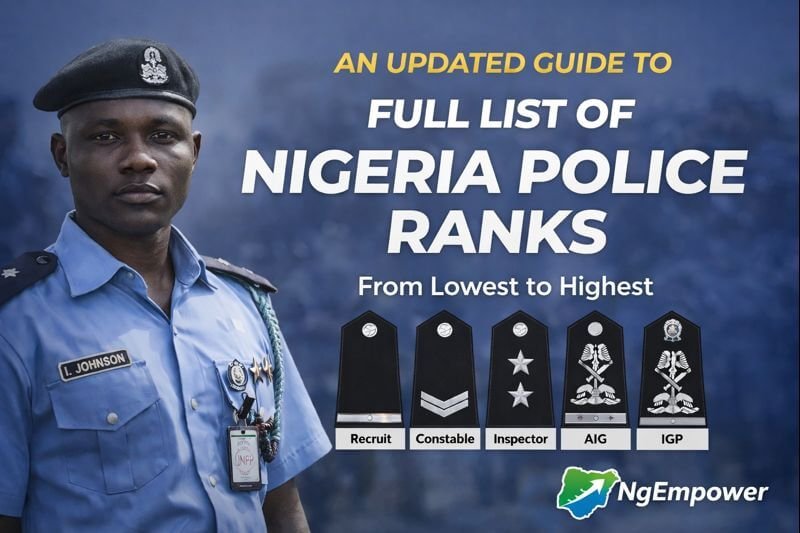
Full List of Nigeria Police Ranks from Lowest to Highest
Here is the official hierarchy of the Nigeria Police Force, arranged from the lowest rank to the highest rank:
Recruit
Constable
Lance Corporal
Corporal
Sergeant
Sergeant Major
Inspector
Assistant Superintendent of Police (ASP)
Deputy Superintendent of Police (DSP)
Superintendent of Police (SP)
Chief Superintendent of Police (CSP)
Assistant Commissioner of Police (ACP)
Deputy Commissioner of Police (DCP)
Commissioner of Police (CP)
Assistant Inspector General of Police (AIG)
Deputy Inspector General of Police (DIG)
Inspector General of Police (IGP)
Below is a detailed explanation of each rank, including duties and position within the police hierarchy.
Junior Police Ranks in Nigeria
Junior ranks are the foundation of the Nigeria Police Force. Officers at this level handle day-to-day policing duties and community security.
Junior ranks form the operational backbone of the Nigeria Police Force and also represent the entry point for most officers. As explained in NgEmpower.com’s breakdown of the Nigeria Police salary structure for recruits and junior officers, these ranks handle frontline duties while building experience for promotion.
1. Recruit (Lowest Rank)
A Recruit is a newly admitted individual undergoing police training.
Key responsibilities:
Undergoes physical, academic, and tactical training
Learns police ethics, laws, and discipline
Not yet authorized to perform full police duties
2. Constable
This is the entry-level operational rank in the Nigeria Police Force.
Duties include:
Patrol and surveillance
Traffic control
Crime prevention and reporting
Assisting senior officers
If you are interested in applying for this position, there’s good news for you, as of the time of publishing this article, recruitment is currently ongoing . check NgEmpower report Nigeria Police Opens Recruitment Portal for 50,000 Constable Positions for 2026 Intake
3. Lance Corporal
A Lance Corporal is a junior supervisory rank above Constable.
Responsibilities:
Supervises Constables
Assists Corporals during operations
Maintains discipline among junior officers
4. Corporal
Corporals take on more responsibility and leadership roles.
Functions:
Leads small police teams
Oversees patrol units
Reports directly to Sergeants
5. Sergeant
Sergeants are key field supervisors in the Nigeria Police hierarchy.
Main duties:
Supervises Corporals and Constables
Coordinates patrol operations
Enforces discipline and reporting
6. Sergeant Major
This is the highest non-commissioned rank before Inspector.
Responsibilities:
Senior supervisory role among junior officers
Acts as link between junior and senior ranks
Maintains order within divisions
Senior Police Ranks in Nigeria
Senior ranks are officers with command authority, strategic responsibilities, and administrative control.
7. Inspector
Inspector is the entry rank into the commissioned officer cadre.
Roles include:
Commands police stations or units
Supervises junior officers
Handles investigations and reports
We have written a detailed guide on How to Become a Police Inspector in Nigeria on NgEmpower.com
8. Assistant Superintendent of Police (ASP)
ASP is usually the starting rank for officers who entered through the Police Academy or direct entry.
Key duties:
Assists higher officers in command
Oversees operations at divisional levels
Coordinates investigations
9. Deputy Superintendent of Police (DSP)
DSPs hold significant leadership roles.
Responsibilities:
Commands divisions
Oversees personnel and logistics
Ensures law enforcement compliance
10. Superintendent of Police (SP)
An SP plays a major operational and administrative role.
Functions:
Heads police divisions
Supervises DSPs and ASPs
Coordinates major security operations
11. Chief Superintendent of Police (CSP)
CSPs are senior commanders within states or formations.
Duties include:
Strategic planning
Supervision of multiple divisions
Advising senior command officers
12. Assistant Commissioner of Police (ACP)
ACP is a high-ranking officer within state commands.
Responsibilities:
Assists Commissioners of Police
Oversees area commands
Implements security policies
13. Deputy Commissioner of Police (DCP)
DCPs are second-in-command at state or specialized commands.
Roles:
Supervises ACPs
Coordinates large-scale operations
Acts on behalf of the Commissioner when necessary
14. Commissioner of Police (CP)
A Commissioner of Police is the head of police operations in a state.
Key duties:
Overall security management of a state
Reports directly to AIG or DIG
Policy implementation and command decisions
15. Assistant Inspector General of Police (AIG)
AIGs oversee multiple state commands within a zone.
Responsibilities:
Supervises Commissioners of Police
Coordinates zonal security strategies
Reports to DIGs
16. Deputy Inspector General of Police (DIG)
DIGs are among the top leadership of the Nigeria Police Force.
Functions:
Oversees major departments or zones
Develops national policing strategies
Reports directly to the IGP
17. Inspector General of Police (IGP) – Highest Rank
The Inspector General of Police is the overall head of the Nigeria Police Force.
Duties:
Commands the entire Nigeria Police Force
Advises the President on internal security
Sets national policing policies
Difference Between Junior and Senior Police Ranks
| Junior Ranks | Senior Ranks |
|---|---|
| Field-based operations | Command and administration |
| Limited authority | Strategic decision-making |
| Entry-level progression | High leadership responsibility |
Nigeria Police Ranks and Their Functions (Summary)
Junior ranks handle patrols, arrests, and daily policing
Senior ranks manage personnel, strategy, and national security policies
Promotion is based on experience, examinations, performance, and training
Frequently Asked Questions (FAQs)
What is the lowest rank in the Nigeria Police Force?
The lowest rank is Recruit, followed by Constable after training.
What is the highest rank in Nigeria Police?
The highest rank is Inspector General of Police (IGP).
How many ranks are in the Nigeria Police Force?
There are 17 official ranks from Recruit to Inspector General.
Are Inspectors senior officers?
Inspectors are the lowest commissioned officers but are part of senior ranks.
Who appoints the Inspector General of Police?
The President of Nigeria, subject to constitutional provisions.
Conclusion
The Nigeria Police Force rank structure is carefully designed to ensure discipline, command efficiency, and national security. From Recruit to Inspector General of Police, each rank plays a critical role in maintaining law and order across Nigeria.
If you found this guide helpful, feel free to share it, bookmark it, or explore related topics on Nigeria’s security and public service structure.
💡 Stay Empowered with NgEmpower
Join our community for daily updates on jobs, skills, and financial growth opportunities.